Kakum Conservancy
Strategic Motivation

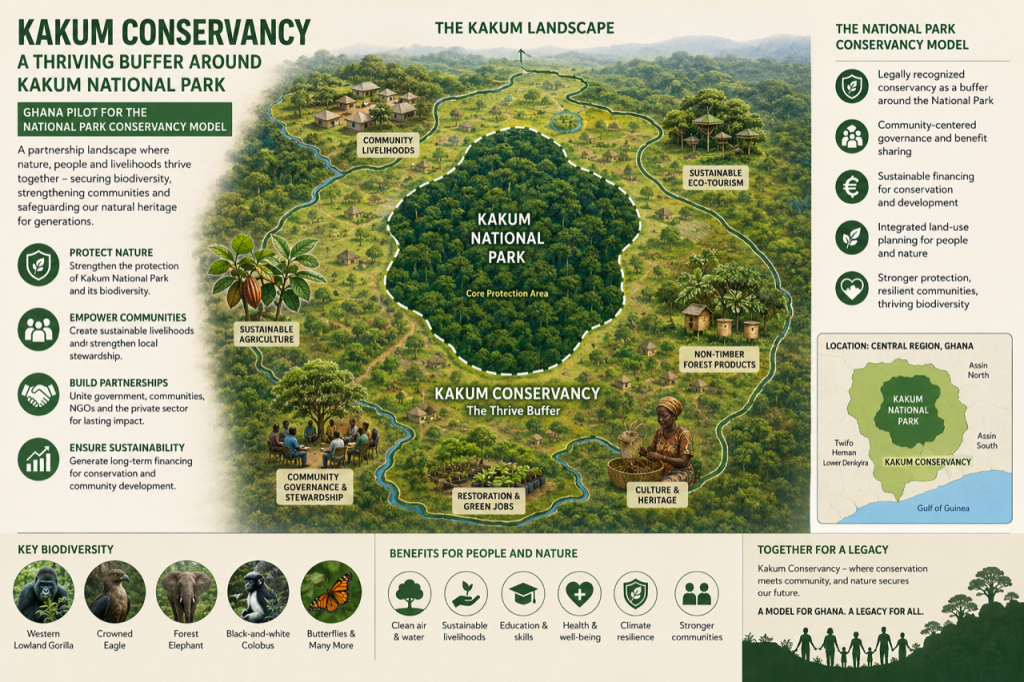
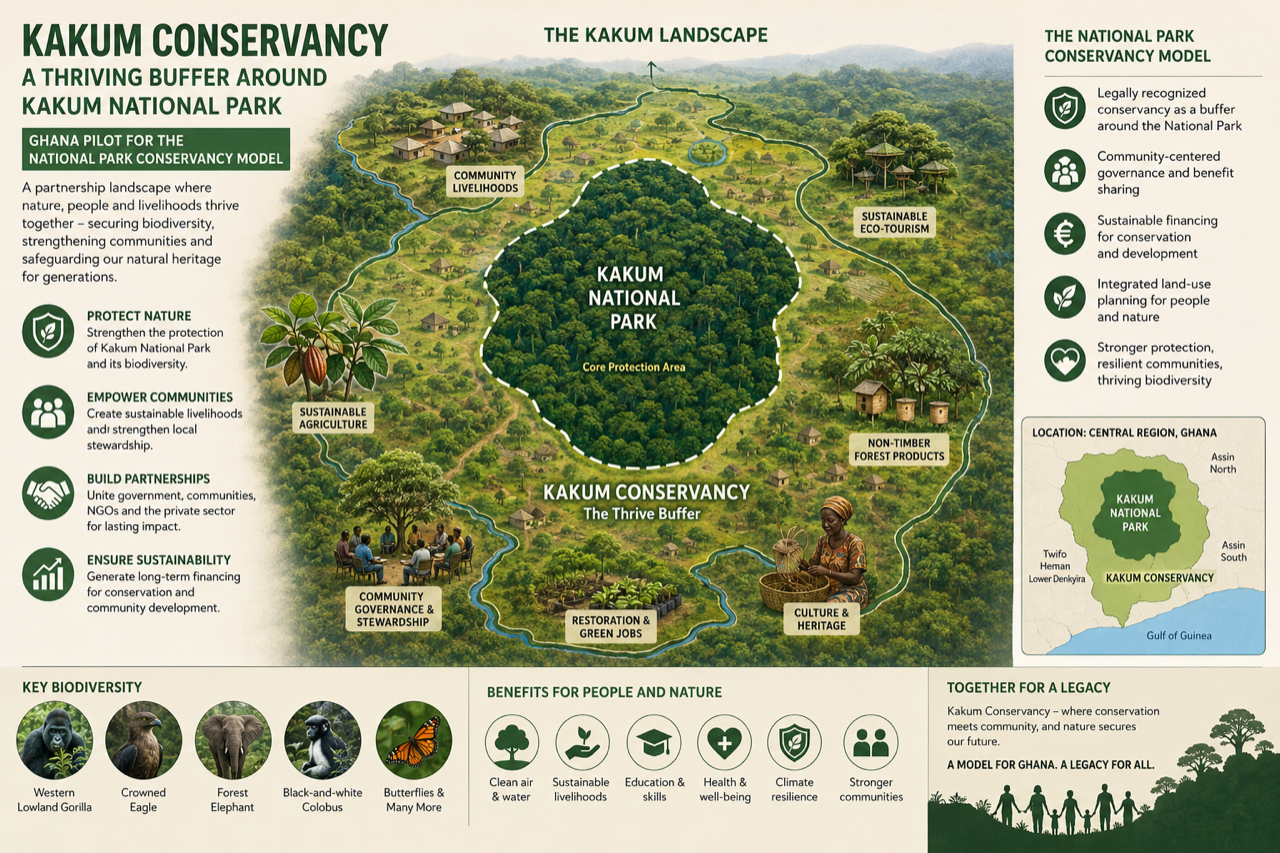
The proposed Kakum Conservancy will create a community-led conservation and sustainable development landscape around Kakum National Park and the wider Kakum Conservation Area in Ghana’s Central Region.
Kakum National Park protects approximately 375 km² of tropical rainforest and is one of Ghana’s best-known protected areas. Its internationally recognised canopy walkway has made Kakum one of the country’s flagship ecotourism attractions. The wider Kakum Conservation Area is also important for species including forest elephant, Diana monkey, bongo and other threatened rainforest fauna.
Importantly, Kakum has a distinctive history of community involvement: Ghana’s Forestry Commission notes that the area originated as a local initiative before subsequently becoming a national park. At the same time, the landscape is surrounded by numerous communities whose livelihoods have historically depended upon agriculture and forest resources.
This creates a compelling opportunity to develop a National Park Conservancy model that connects conservation with community ownership, enterprise, tourism, restoration and investment.
The objective would not be to replace the statutory management of Kakum National Park. Rather, the proposed Conservancy would provide a complementary community and economic development platform around the protected area, bringing together government, traditional authorities, communities, conservation organisations, tourism operators, investors and development partners.
The Strategic Opportunity
Kakum already has one of the most recognisable rainforest tourism propositions in Ghana. The Ghana Tourism Authority has identified Kakum as one of the country’s most visited tourism sites and has actively promoted the park through its national tourism campaigns.
The opportunity for Rewilding Africa is therefore to move the proposition beyond simply:
“visit the canopy walkway”
towards:
“experience, protect and invest in the Kakum rainforest landscape.”
The Conservancy could create a wider destination in which rainforest conservation generates tangible economic opportunities for surrounding communities.
This would potentially connect:
National Park → community conservation → sustainable agriculture → forest restoration → tourism → community enterprise → investment → long-term conservation finance.
A central strategic principle would be:
Protect the forest. Empower the communities. Grow the conservation economy.
Phase 1 Strategy
Kakum Conservancy – Advocacy, Planning, Destination Development & Investment Activation
Phase 1 objective:
To establish the strategic, institutional, commercial and investment foundations for the Kakum Conservancy, creating a credible platform for community-led conservation and sustainable economic development around Kakum National Park.
Phase 1 would be a mobilisation and market-development phase, rather than the implementation of the full physical Conservancy.
1. Stakeholder & Partnership Mobilisation
The first priority would be to establish a broad Kakum Conservancy Partnership Platform.
Rewilding Africa would seek to work collaboratively with:
- Ghana Forestry Commission / Wildlife Division
- Ghana Tourism Authority
- Relevant central and local government authorities
- Traditional authorities
- Communities surrounding Kakum
- Existing conservation NGOs
- Tourism and hospitality operators
- Universities and research institutions
- Agricultural organisations
- Private-sector partners
- Carbon and biodiversity-finance organisations
- Development-finance institutions
- International conservation and philanthropic organisations
The purpose would be to establish a shared vision and determine the appropriate governance and partnership structure for the Conservancy.
2. Kakum Landscape & Opportunity Assessment
Phase 1 would undertake a strategic assessment of the landscape surrounding Kakum.
This would identify:
- Existing protected areas
- Community lands
- Agricultural areas
- Forest corridors
- Degraded landscapes
- Restoration opportunities
- Tourism assets
- Community enterprises
- Potential conservation zones
- Potential investment opportunities
The initial assessment would provide the foundation for the more detailed land-use mapping, zoning and community planning envisaged under Phase 2.
3. Kakum Rainforest Conservancy Destination Brand
A major Phase 1 output would be the creation of a Kakum Conservancy Destination Brand & Marketing Strategy.
The ambition would be to establish Kakum not simply as a national park attraction, but as a world-class community-led rainforest destination.
The destination proposition could bring together:
Wildlife
Forest elephant, primates, birds and other rainforest species.
Adventure
Canopy walks, forest trekking and specialist nature experiences.
Culture
Traditional communities, local food, heritage and storytelling.
Conservation
Hands-on conservation, restoration and biodiversity experiences.
Science
Research, ecological monitoring and educational expeditions.
Sustainable Enterprise
Cocoa, forest products, crafts, hospitality and local services.
Wellness & Nature
Forest bathing, retreats and immersive rainforest experiences.
The strategy would complement Ghana’s existing destination marketing activities rather than compete with them. The Ghana Tourism Authority already positions itself as Ghana’s national destination marketing organisation and has a strong focus on sustainable tourism.
4. Community Conservation Marketplace
One of the most commercially interesting opportunities would be to establish a Kakum Community Conservation Marketplace.
This could eventually provide an international and domestic platform for community-produced goods and services associated with the Conservancy.
Potential categories could include:
- Cocoa and chocolate
- Sustainable agricultural products
- Honey
- Handcrafts
- Local food
- Community accommodation
- Forest guides
- Cultural experiences
- Conservation experiences
- Educational programmes
- Photography and filming experiences
- Research and expedition services
This would create a direct link between conservation and household economic opportunity.
The ambition would be to ensure that increasing visitation to Kakum generates a wider economic footprint beyond the park gate.
5. Sustainable Cocoa & Forest-Friendly Agriculture
Agriculture should form an important component of the Kakum Conservancy strategy.
Phase 1 would identify opportunities for:
- Forest-friendly cocoa
- Agroforestry
- Shade-grown crops
- Sustainable farming
- Soil restoration
- Watershed protection
- Community nurseries
- Indigenous tree planting
- Sustainable agricultural value chains
The objective would be to develop agricultural landscapes that act as a productive buffer and ecological transition zone around the protected forest, reducing pressure on the core conservation area while increasing farmer incomes.
6. Ecological Restoration & Rewilding Strategy
Phase 1 would identify priority opportunities for landscape restoration around Kakum.
Potential interventions could include:
Forest → degraded land → restoration corridor → agroforestry → community conservation landscape
Priority areas could eventually include:
- Forest edges
- Degraded agricultural land
- Riparian corridors
- Wildlife movement routes
- Community forests
- Buffer landscapes
- Areas requiring native tree restoration
The longer-term ambition would be to create a connected rainforest landscape rather than an isolated protected-area island.
7. Investment & Conservation Finance Proposition
Phase 1 would develop a Kakum Conservancy Investment Prospectus.
Potential funding and investment streams could include:
- Conservation philanthropy
- Climate finance
- Carbon finance
- Biodiversity finance
- Tourism investment
- Impact investment
- Community enterprise finance
- Corporate partnerships
- Development finance
- Grants
- Blended finance
Ghana already has institutional mechanisms supporting tourism development and marketing through the Tourism Development Fund, including tourism infrastructure, market research, product development and entrepreneurial activities.
The Rewilding Africa CIC model would seek to complement these mechanisms by creating a larger, integrated conservation investment proposition.
8. International Advocacy & Fundraising Campaign
Phase 1 would culminate in a Kakum Rainforest Conservancy International Campaign.
The campaign would position Kakum as:
A flagship community-led rainforest conservation and sustainable tourism landscape in West Africa.
The campaign could target:
- International conservation funders
- Family offices
- Impact investors
- Tourism investors
- Corporate sponsors
- Climate and biodiversity funds
- Universities
- International NGOs
- Responsible tourism companies
- Diaspora networks
- Philanthropic foundations
Rewilding Africa CIC could provide the international advocacy, destination marketing, partnership development and fundraising platform, working with Ghanaian partners responsible for local relationships and implementation.
Phase 1 Key Outputs
At the end of Phase 1, the Kakum Conservancy programme should aim to have developed:
- Kakum Conservancy Strategic Framework
- Stakeholder & Partnership Platform
- Community Engagement Strategy
- Preliminary Conservancy Landscape Assessment
- Destination Brand & Marketing Strategy
- Kakum Tourism & Conservation Experience Portfolio
- Community Enterprise Opportunity Assessment
- Forest-Friendly Agriculture & Restoration Opportunity Framework
- Investment & Conservation Finance Prospectus
- International Advocacy & Fundraising Campaign
- Phase 2 Development Roadmap
Phase 2 – Potential Development Pathway
Subject to stakeholder agreement and successful Phase 1 fundraising, the Kakum Conservancy could progress into the Rewilding Africa Phase 2 National Park Conservancy Development Programme.
The programme would potentially encompass the eight-stage model:
1. Natural Resource Audits
2. Comprehensive Community Planning
3. Land-Use Mapping & Zoning
4. Conservancy Governance / SPV Structures
5. Destination Marketing & Investable Concessions
6. Social-Impact Investment & Community Enterprise Development
7. Rewilding & Landscape Restoration
8. Long-Term Conservancy Management & Business Development
The ultimate ambition would be to establish Kakum as a flagship Ghanaian demonstration of community-led conservation, showing how a major national park can become the anchor of a much larger conservation, tourism and rural-development economy.
Kakum Conservancy Positioning
Ghana | Community-led rainforest conservation, enterprise & sustainable tourism
The proposed Kakum Conservancy seeks to create a community-led conservation and sustainable development landscape around Kakum National Park and the wider Kakum Conservation Area in Ghana.
Building upon Kakum’s exceptional rainforest biodiversity, established tourism profile and surrounding communities, the initiative aims to connect conservation, community enterprise, sustainable agriculture, ecological restoration, responsible tourism, climate and biodiversity finance and international investment.
Phase 1 will focus on advocacy, stakeholder mobilisation, strategic planning, destination branding, investment preparation and fundraising, creating the platform for a potential Phase 2 Conservancy development programme.
The long-term ambition is to demonstrate that the conservation of Ghana’s rainforest can become an engine for community prosperity, sustainable tourism and landscape restoration – creating a replicable model for other national parks and protected areas across Ghana and Africa.