
Amboseli Conservancy
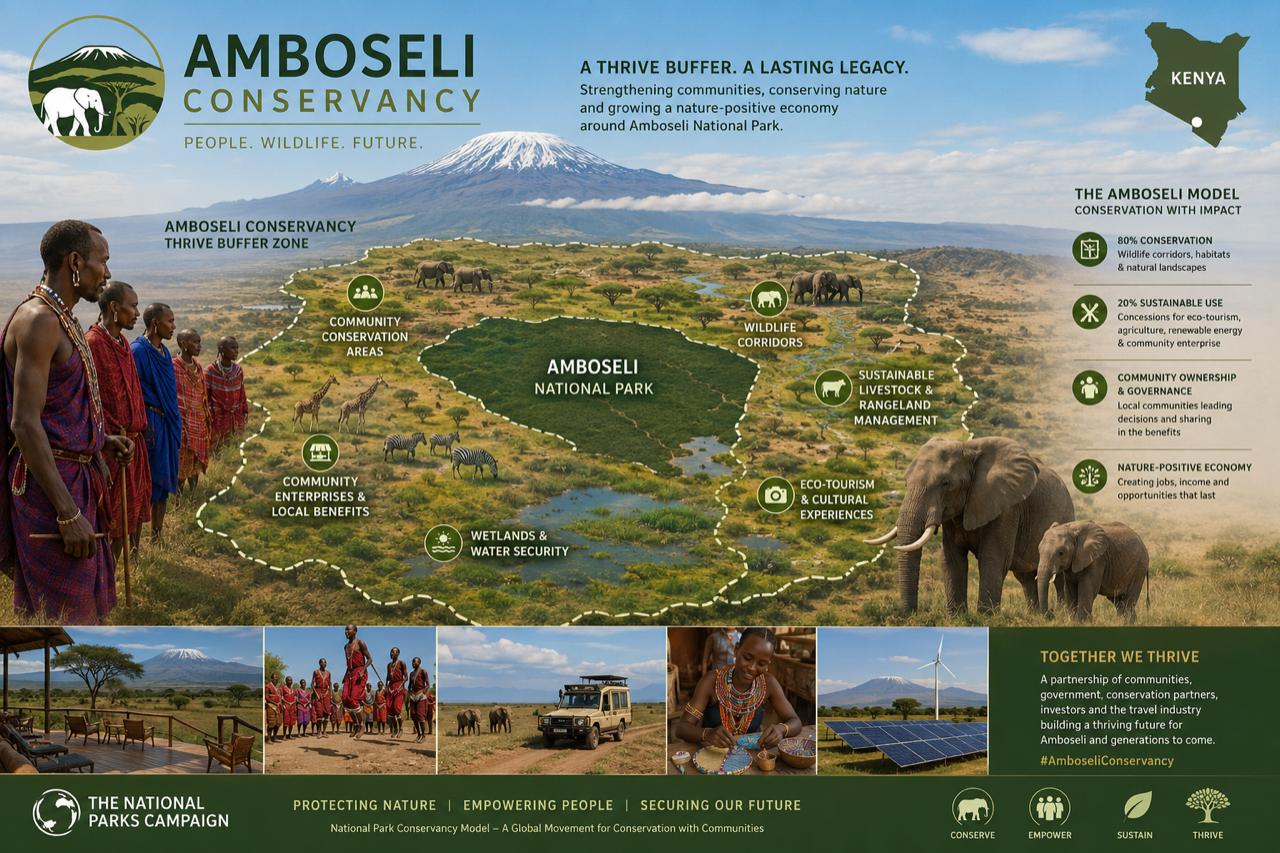
AMBOSELI CONSERVANCY
National Park Conservancy Model – Phase 1 Motivation & Strategy Overview
A flagship Kenya pilot for the Rewilding Africa National Park Conservancy Model
The Opportunity
Amboseli is one of Africa’s most iconic conservation landscapes.
At its heart is Amboseli National Park, internationally renowned for its elephants, extraordinary views of Mount Kilimanjaro, wetlands, open savannah and exceptional wildlife experience. But the ecological reality of Amboseli extends far beyond the formal boundary of the National Park.
The park is the protected core of a much larger living ecosystem in which wildlife, livestock, communities, tourism and natural resources are interconnected.
This makes Amboseli an ideal potential Kenyan pilot for the Rewilding Africa National Park Conservancy (NPC) model.
The proposed Amboseli Conservancy would not replace the National Park, Kenya Wildlife Service, existing community conservancies, the Amboseli Ecosystem Trust or other established conservation institutions.
Instead, it would seek to create a unifying destination, investment and development framework around the National Park, connecting existing conservation, community, tourism and land-use initiatives into a stronger and more marketable ecosystem-wide proposition.
The ambition is simple:
To make Amboseli one of Africa’s leading examples of a National Park surrounded and supported by a thriving community-led conservation economy.
Why Amboseli?
Amboseli demonstrates perhaps more clearly than almost any other African landscape why the future of a National Park depends upon what happens beyond its boundaries.
Amboseli National Park covers only a relatively small part of the wider ecosystem. Wildlife uses surrounding community lands, dispersal areas and seasonal corridors, while pastoral communities depend upon the same landscape for livestock, water and livelihoods.
The Amboseli Ecosystem Management Plan 2020–2030 already recognises the importance of wildlife corridors, community conservancies, land-use planning, habitat restoration and sustainable livelihoods. It specifically identifies threats including land subdivision, settlement, agricultural expansion, fencing, water extraction and the loss of seasonal grazing and wildlife areas.
This provides a strong strategic foundation for an NPC pilot.
The opportunity is therefore to move from:
National Park + surrounding conservancies
towards:
National Park + connected community conservancies + wildlife corridors + sustainable land use + tourism + community enterprise + investment = Amboseli Conservancy.
The Strategic Motivation
The motivation for establishing an Amboseli Conservancy as an NPC pilot is based on five interconnected priorities.
1. Secure the ecological future of Amboseli
Wildlife movement cannot be contained within the National Park.
The ecosystem’s elephants and other large mammals depend upon surrounding community lands, seasonal dispersal areas and corridors connecting Amboseli with the wider landscape and Tanzania.
The existing ecosystem plan identifies important corridors including the Amboseli-Olgulului-Eselenkei corridor, the Amboseli – Kimana-Kuku- Chyulu West corridor and the Amboseli-Olgulului South–Kitenden-Kilimanjaro corridor. These areas face pressures from settlement, agriculture, fencing and tourism development.
The Amboseli Conservancy would provide a destination-level framework for helping secure these critical ecological connections.
2. Strengthen community custodianship
The future of Amboseli will ultimately depend upon communities seeing wildlife and conservation as valuable land uses.
The National Park Conservancy model is founded on the principle that communities should not simply be regarded as beneficiaries of conservation, but as landowners, custodians, entrepreneurs and partners in the conservation economy.
This is particularly relevant in Amboseli’s Maasai community landscape, where pastoralism, wildlife and tourism already coexist.
The objective would be to expand the economic value generated from conservation-compatible land uses while supporting community decision-making, enterprise development and sustainable livelihoods.
3. Create a unified destination proposition
Amboseli is already a globally recognised tourism destination.
However, the visitor proposition is still largely understood through the lens of the National Park.
The NPC opportunity is to market the whole ecosystem as a destination.
This could incorporate:
• Amboseli National Park
• Community conservancies
• Wildlife corridors
• Maasai cultural experiences
• Conservation tourism
• Community-owned enterprises
• Walking and specialist safari experiences
• Conservation research and education
• Adventure and expedition tourism
• Sustainable hospitality
• Regenerative tourism
• Conservation volunteering
• Corporate and social-impact travel
• Nature-positive investment opportunities
The objective is to increase both the economic value and geographic distribution of tourism, so that a greater proportion of the conservation economy reaches communities and landscape-level conservation.
4. The Amboseli Conservancy Concept
The proposed Amboseli Conservancy should be understood as a destination and landscape framework, rather than a single new protected area.
Its final geographical footprint would be developed through stakeholder consultation and technical assessment during Phase 1.
Potential landscape components could include areas associated with:
• Olgulului–Lolarashi
• Kimana
• Kuku
• Kitenden
• Eselenkei
• surrounding community conservancies and dispersal areas
• important wildlife corridors
• key wetland and water systems
• selected tourism and community enterprise zones
The exact boundaries are not predetermined by Rewilding Africa CIC.
They emerge through a participatory process involving the relevant government agencies, communities, landowners, conservancies, county government, conservation organisations, tourism stakeholders and other rights holders.
5. Phase 1 – Destination Branding & Market Activation
The proposed Phase 1 programme is a strategic mobilisation and destination development programme.
It establishes the proposition, partnerships, brand, investment case and shared market platform.
Phase 1 objective
To establish Amboseli Conservancy as a globally recognised, community-centred, conservation-led destination and investment proposition, creating the strategic foundation for subsequent conservancy development.
Phase 1 should therefore be deliberately focused on strategy, destination development, stakeholder alignment, investment mobilisation and market activation, rather than attempting to implement the proposed phase 2 programme.
6. Core Phase 1 Workstreams
Workstream 1 – Stakeholder mobilisation
Establish an inclusive stakeholder platform involving, as appropriate:
• Kenya Wildlife Service
• Kajiado County Government
• Amboseli Ecosystem Trust
• community conservancies
• community and traditional leadership
• landowners
• conservation NGOs
• research institutions
• tourism operators
• private-sector investors
• development partners
• social-impact investors
• relevant national government agencies
The objective would be to establish shared ownership of the Amboseli Conservancy proposition.
Workstream 2 – Amboseli Conservancy Destination Strategy
Develop a single strategic proposition for the wider destination.
This would define:
Vision
Mission
Geographic concept
Conservation proposition
Community proposition
Tourism proposition
Investment proposition
Enterprise proposition
Brand proposition
Governance principles
Market positioning
Implementation pathway
7. The “Thriving Buffer” Concept
A central proposition is the creation of a thriving buffer around Amboseli National Park.
This should not be interpreted simply as a physical buffer zone.
It is a living economic and ecological landscape in which conservation-compatible land uses generate value for communities while maintaining connectivity for wildlife.
The ambition could be expressed as:
A thriving buffer of community-owned and community-supported conservation landscapes surrounding Amboseli National Park, creating space for wildlife, sustainable pastoralism, nature-based enterprise and responsible tourism.
This directly supports the NPC philosophy that the areas surrounding National Parks should become economically successful because they are valuable for conservation.
8. Destination Branding
A major Phase 1 output is the creation of the Amboseli Conservancy brand.
The brand sits alongside, rather than replaces, the existing identities of Amboseli National Park, Kenya Wildlife Service, individual conservancies and conservation organisations.
The proposition could be built around:
AMBOSELI CONSERVANCY
“Kenya’s Living Elephant Landscape”
The final brand will emerge through stakeholder consultation and professional destination-brand development.
9. Tourism as a Conservation Financing Mechanism
The Amboseli Conservancy proposition seeks to move tourism beyond simply generating visitor expenditure.
Tourism should become a mechanism for financing:
conservation + communities + corridors + restoration + enterprise.
10. Governance Principle
The Amboseli Conservancy is designed around a principle of collaboration rather than institutional replacement.
Existing statutory and community institutions retain their respective mandates.
The NPC framework potentially provides an additional strategic layer that connects:
Government
Communities
Conservancies
Conservation organisations
Tourism
Private sector
Investors
Research
International markets
The precise governance and legal structure is determined through Phase 1 stakeholder engagement and legal/technical assessment.
11. Why This Could Become a Kenyan National Pilot
Amboseli offers an unusually powerful demonstration opportunity for the National Park Conservancy model.
It already has:
• a globally recognised National Park
• globally significant elephants
• internationally recognised conservation research
• established community conservation initiatives
• critical wildlife corridors
• a major international tourism market
• strong conservation institutions
• an established ecosystem management framework
• community land surrounding the protected area
• significant opportunities for tourism and enterprise development.
The existing Amboseli Ecosystem Management Plan explicitly supports the establishment and strengthening of community wildlife conservancies and the protection of wildlife corridors.
Kenya Wildlife Service’s current strategic framework also places emphasis on reversing wildlife decline, restoring ecosystems, addressing habitat fragmentation and increasing the benefits communities receive from wildlife.
The NPC model can therefore be positioned as a delivery and market-activation framework that complements existing Kenyan conservation policy and planning.
12. Phase 2 – Possible National Park Conservancy Development Programme
Subject to the successful completion of Phase 1 and agreement with the relevant stakeholders, the Amboseli Conservancy could become a candidate for the full Phase 2 National Park Conservancy Development Programme.
Phase 2 would move from strategy and market activation into practical conservancy planning, development and management.
The proposed eight-step framework includes:
1. Natural Resource Audits
Establish a detailed ecological, social and economic baseline.
2. Comprehensive Community Planning
Work with communities and landowners to define future land-use priorities.
3. Land-Use Mapping & Zoning
Identify conservation areas, wildlife corridors, grazing areas, settlement areas, tourism zones, enterprise areas and restoration landscapes.
4. Legal Entities & Governance
Develop appropriate community and conservancy structures, agreements and governance mechanisms.
5. Destination Marketing & Investable Land Leases
Create a pipeline of tourism and conservation-compatible investment opportunities.
6. Social Impact Investment & Community Enterprise
Develop enterprises and mobilise capital around the People + Planet + Profit model.
7. Rewilding & Landscape Restoration
Restore degraded habitats, secure corridors and strengthen ecological connectivity.
8. Long-Term Conservancy Management & Business Development
Establish the systems required for ongoing landscape management, marketing, investment and enterprise development.
13. The Potential End State
The long-term ambition would be to establish the Amboseli Conservancy as:
A globally recognised National Park Conservancy in which a protected national park is embedded within a thriving community-owned conservation economy.
The model demonstrates that:
The National Park protects the core.
The National Park Conservancy gives the communities shared ownership.
Tourism creates economic value.
Enterprise distributes that value.
Investment accelerates development.
Restoration strengthens the landscape.
Communities become custodians and shareholders in the future of conservation.
14. Phase 1 Outcomes
At the end of Phase 1, the Amboseli Conservancy will have:
1. A clearly defined destination proposition.
2. A stakeholder-supported strategic framework.
3. A preliminary geographic and ecosystem framework.
4. A comprehensive destination brand.
5. A marketing and communications strategy.
6. A tourism and visitor experience strategy.
7. A market activation programme.
8. A roadmap towards Phase 2 implementation.
9. A flagship international campaign positioning the Amboseli Conservancy as a model for community-led conservation.
Sorry, no records were found. Please adjust your search criteria and try again.
Sorry, unable to load the Maps API.