
Bwindi Conservancy
EXECUTIVE SUMMARY
Bwindi Conservancy would be developed as a community-led conservation and destination development initiative surrounding Bwindi Impenetrable National Park, one of Africa’s most important mountain gorilla and biodiversity landscapes. Building on the park’s existing community conservation, revenue-sharing and ecotourism initiatives, the pilot would seek to create a stronger, integrated destination brand and sustainable economic model linking conservation, communities, culture, tourism and private-sector investment.
Particular emphasis would be placed on strengthening community enterprise, creating nature-positive livelihoods, supporting local tourism businesses and ensuring that the economic value generated by the gorilla and wider ecosystem reaches the communities living alongside the park. The initiative would be developed collaboratively with Uganda Wildlife Authority, government, local authorities, community leadership, conservation organisations and private-sector partners, with the ambition of creating a globally recognised model of community-led conservation in the Albertine Rift.
NATIONAL PARK CONSERVANCY MODEL AND 2 PHASE PROGRAM for Bwindi Conservancy, Uganda
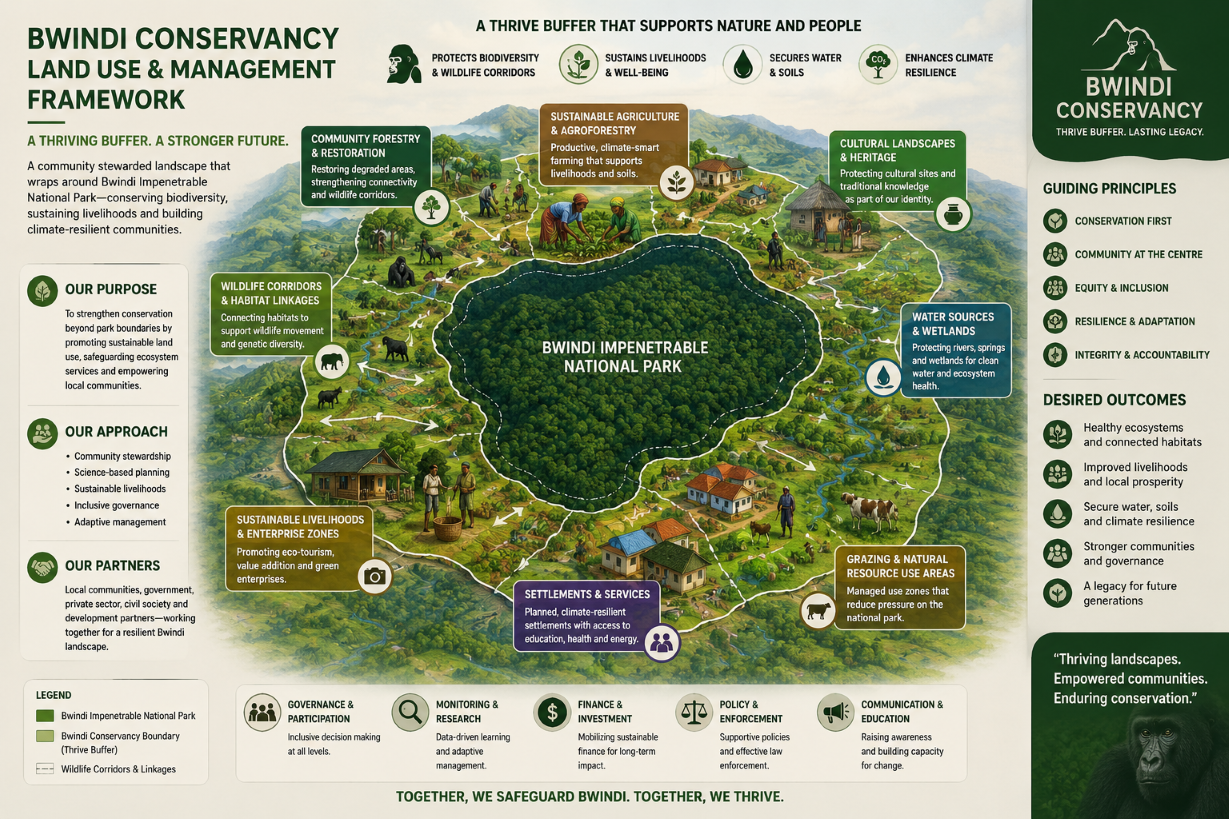
A community-led conservation and sustainable development landscape around Bwindi Impenetrable National Park
The Bwindi Conservancy is proposed as a flagship Uganda pilot for Rewilding Africa CIC’s National Park Community Conservancy (NPC) model – an approach designed to create thriving conservation and sustainable development landscapes around Africa’s national parks.
Centred on Bwindi Impenetrable National Park and the communities, forests, agricultural landscapes, tourism businesses and conservation initiatives surrounding it, the Bwindi Conservancy seeks to strengthen the connection between forest conservation, community livelihoods, responsible tourism, enterprise development and landscape restoration.
The Conservancy would complement, rather than replace, the existing management and protection of Bwindi Impenetrable National Park, creating a wider framework through which neighbouring communities and private-sector stakeholders can participate in and benefit from the conservation economy.
The opportunity
Bwindi is internationally recognised for its exceptional biodiversity and as one of the most important habitats for the critically endangered mountain gorilla. Its conservation future is intrinsically linked to the wellbeing and economic opportunities of the communities living around the forest.
The Bwindi Conservancy provides an opportunity to develop a coordinated landscape proposition in which conservation and community prosperity become mutually reinforcing objectives.
Through appropriate planning and stakeholder collaboration, the Conservancy could support wildlife and habitat protection, sustainable agriculture, community-based tourism, cultural experiences, conservation enterprises, hospitality, environmental restoration and other nature-positive businesses.
The underlying principle is:
The long-term protection of Bwindi depends not only on protecting the forest, but on creating a thriving economy and sustainable future for the communities that surround it.
Rewilding Africa’s proposed role
Rewilding Africa CIC proposes to work collaboratively with the relevant Ugandan authorities, Uganda Wildlife Authority, conservation organisations, community representatives, local leadership, tourism stakeholders, landowners, development partners and responsible investors to explore and develop the Bwindi Conservancy as a Uganda country pilot for the National Park Conservancy model.
The initial programme would focus on Phase 1 – Destination Strategy, Branding and Market Activation, establishing the shared vision, destination identity, stakeholder platform, market proposition, investment narrative and roadmap for the Conservancy.
Subject to stakeholder support and funding, a subsequent Phase 2 Conservancy Planning and Development Programme could address detailed natural-resource assessment, comprehensive community planning, land-use mapping and zoning, governance structures, conservation and tourism concessions, community enterprise development, landscape restoration and long-term conservancy management.
A conservation economy around Bwindi
The Bwindi Conservancy has the potential to create a globally recognised model where:
• Bwindi’s forest and biodiversity are protected and restored
• Mountain gorilla conservation is strengthened through landscape-scale action
• Communities gain greater economic value from conservation
• Responsible tourism creates wider local employment and enterprise opportunities
• Community businesses can access domestic and international markets
• Nature-positive investment is attracted to the surrounding landscape
• Sustainable agriculture and regenerative land-use practices are encouraged
• Forest, habitat and ecological connectivity are strengthened
• Conservation becomes an increasingly attractive economic land-use choice
The opportunity is to build upon Bwindi’s extraordinary international profile and create a broader destination brand and conservation economy extending beyond the boundaries of the national park.
Phase 1 ambition
The first phase would establish the Bwindi Conservancy destination proposition, bringing together conservation, community, tourism and investment interests around a common vision.
The objective is to develop a compelling and investable platform capable of attracting conservation finance, responsible tourism investment, philanthropic and development funding, social impact investment and private-sector participation.
Bwindi could become an important demonstration of how one of Africa’s most iconic protected areas can act as the anchor for a much wider community-led conservation and sustainable development landscape.
Bwindi Conservancy – protecting the forest, empowering communities and building a thriving conservation economy around one of Africa’s most precious ecosystems.
Sorry, no records were found. Please adjust your search criteria and try again.
Sorry, unable to load the Maps API.