
Congo Basin Conservancy
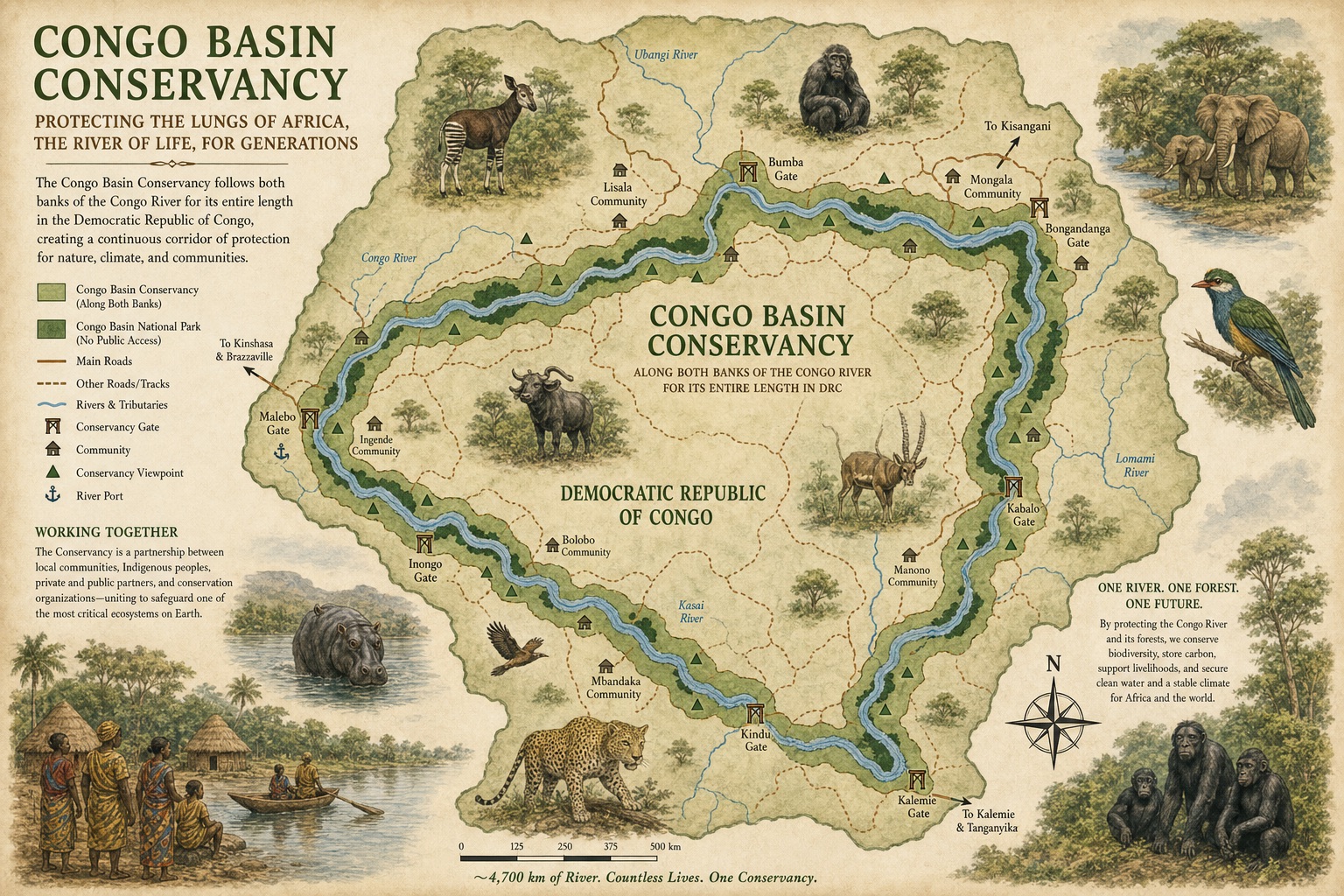
Congo Basin Conservancy
Strategic Motivation
The Congo Basin Conservancy is envisioned as a landscape-scale community-led conservation initiative designed to strengthen the protection, connectivity and economic sustainability of the Congo Basin’s globally significant forests, wildlife and protected areas.
The Congo Basin represents one of the most important remaining natural ecosystems on Earth, supporting exceptional biodiversity, major carbon stores and millions of people whose livelihoods are directly connected to the landscape. Yet protected areas alone cannot secure this ecosystem. The long-term future of the Congo Basin depends on creating stronger partnerships between governments, protected-area authorities, local and indigenous communities, conservation organisations, responsible private-sector interests and impact investors.
Rewilding Africa CIC proposes to explore the National Park Conservancy model as a framework for creating thriving conservation buffers and connected landscapes around selected protected areas across the Congo Basin. The approach is centred on community-led conservation, sustainable land-use planning, nature-positive enterprise and the creation of investable opportunities that generate tangible benefits for local communities while strengthening conservation outcomes.
The objective is not to replace existing protected-area management, but to create a complementary conservancy landscape and community led conservation destination brand around and between protected areas, bringing stakeholders together around a shared vision, destination identity, investment proposition and long-term development strategy.
Phase 1 – Advocacy, Partnership , Destination Strategy & Launch
Phase 1 would establish the strategic foundation required to determine the feasibility and potential location of a Congo Basin Conservancy and to build the partnerships required for a future Phase 2 development programme.
The initial focus would be on:
1. Strategic Advocacy & Stakeholder Engagement
Introduce the National Park Conservancy model to relevant government authorities, protected-area agencies, conservation organisations, community and indigenous representatives, development partners and responsible private-sector stakeholders.
2. Conservancy Vision & Destination Proposition
Develop an initial Congo Basin Conservancy vision and destination proposition that connects biodiversity, forests, wildlife, communities, culture, tourism and sustainable investment.
3. Market & Investment Strategy
Assess potential markets and nature-positive investment opportunities, including conservation tourism, community enterprises, sustainable land uses, carbon and biodiversity finance and other appropriate impact-investment mechanisms.
4. Phase 1 Communications & Fundraising
Build the advocacy, communications and fundraising platform required to attract catalytic funding and strategic partners for the next stage of development.
5. Phase 2 Development Roadmap
Produce a clear roadmap for progression into Phase 2, including the potential for detailed natural-resource assessment, community planning, land-use mapping and zoning, governance structures, investment-ready projects, restoration and long-term conservancy management.
The Strategic Opportunity
The Congo Basin Conservancy has the potential to become a new model for community-led landscape conservation in Central Africa – connecting protected areas with the communities and economies that surround them.
Through the National Park Conservancy model, Rewilding Africa CIC seeks to help create a framework where conservation, community ownership, sustainable enterprise and impact investment work together, providing a stronger and more sustainable future for one of the world’s most important remaining natural landscapes.
Phase 1 objective: Build the partnership, vision, destination strategy and investment proposition required to establish a viable Congo Basin Conservancy and unlock a future Phase 2 programme.
Sorry, no records were found. Please adjust your search criteria and try again.
Sorry, unable to load the Maps API.